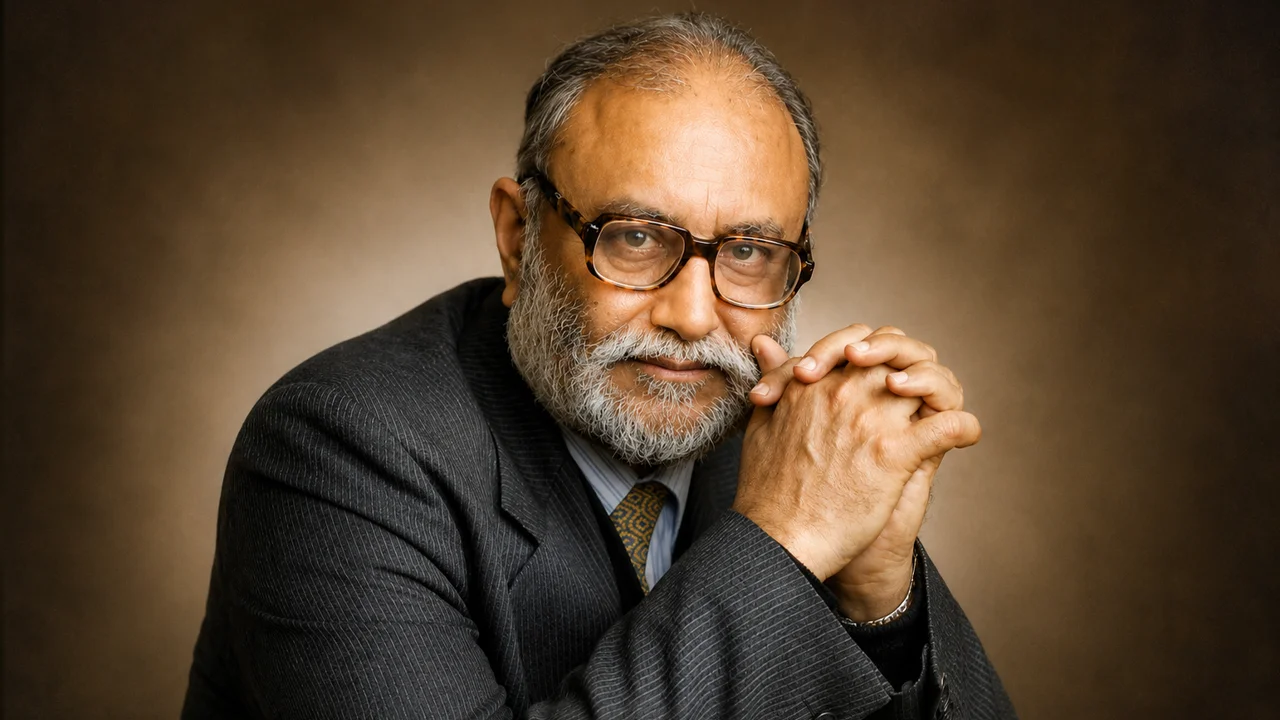



Dr. Nergis Mavalvala
Published On 07 Nov, 2026

SCIENTIFIC PAKISTANI | THE LEADERSHIP ARCHIVES
Dr. Nergis Mavalvala – The Pakistani-Born Physicist Who Helped Humanity Hear the Universe
A Tribute to the Scientist Behind the Historic Detection of Gravitational Waves
Dr. Nergis Mavalvala is a Pakistani-born experimental physicist renowned for her pioneering work in gravitational-wave detection and quantum measurement science. Born in Lahore, Pakistan, and raised in Karachi, she went on to become one of the leading scientists at the Massachusetts Institute of Technology (MIT), where she serves as Dean of the School of Science and the Curtis (1963) and Kathleen Marble Professor of Astrophysics. Her work has helped open a new way of observing the universe and understanding some of its most powerful events.
The Scientific Breakthrough: Detecting Ripples in Space-Time
For generations, scientists relied mainly on light and other forms of electromagnetic radiation to study distant objects in space. But Albert Einstein’s theory of general relativity predicted another way to observe the universe: gravitational waves—tiny ripples in the fabric of space-time produced by violent cosmic events such as colliding black holes.
Detecting these waves required instruments capable of measuring extraordinarily small changes in distance. Dr. Mavalvala became a key member of the international scientific effort to make this possible through the Laser Interferometer Gravitational-Wave Observatory (LIGO).
The Technology: During her doctoral research at MIT, Mavalvala worked with physicist Rainer Weiss on developing laser interferometer technology for gravitational-wave detection. Her research helped address the difficult challenge of keeping the detector's instruments precisely aligned and stable.
The Historic Discovery: In September 2015, LIGO made the first direct detection of gravitational waves, produced by two merging black holes. The discovery was announced publicly in February 2016 and marked a turning point in modern astronomy.
The Scientific Impact: Mavalvala's contributions to detector technology and the wider LIGO effort helped make this achievement possible. The discovery opened a new field of gravitational-wave astronomy, allowing scientists to study cosmic events that cannot be observed through ordinary light alone.
Beyond LIGO: Exploring the Quantum Universe
Dr. Mavalvala's research extends beyond detecting gravitational waves. She has also worked on quantum measurement science, exploring how the principles of quantum mechanics affect the precision of scientific instruments.
One important area of her research involves squeezed states of light. These specially prepared quantum states can reduce certain types of measurement noise, helping instruments detect extremely weak signals. Such techniques have become important in efforts to improve the sensitivity of gravitational-wave detectors.
She has also conducted experiments involving laser cooling and trapping of macroscopic objects. These studies explore how quantum behaviour can be investigated in objects much larger than individual atoms, bringing together ideas from optics, quantum mechanics and experimental physics.
Breaking Barriers: Leadership at MIT
Dr. Mavalvala's journey from Pakistan to one of the world's leading scientific institutions reflects years of academic dedication and research excellence.
She completed her undergraduate studies at Wellesley College, earning a bachelor's degree in physics and astronomy in 1990. She then joined MIT, where she completed her PhD in physics in 1997. After working as a postdoctoral researcher and research scientist at the California Institute of Technology (Caltech), she returned to MIT as a faculty member in 2002.
In September 2020, she became Dean of MIT's School of Science, making history as the first woman to hold the position. Her leadership has focused not only on scientific excellence but also on student support, mentorship, inclusion and collaboration across different fields of research.
As a department leader, she also helped introduce improvements to graduate education, academic advising and mentoring programmes. Her work reflects a belief that a strong scientific community needs both groundbreaking research and an environment where people from different backgrounds can succeed.
Global Recognition: Awards and Achievements
Dr. Mavalvala's contributions have earned recognition from leading scientific and academic organizations around the world.
Some of her major honours include:
- MacArthur Fellowship (2010): Recognized for her innovative work in astrophysics and quantum measurement.
- Gruber Cosmology Prize (2016): Awarded to the LIGO Discovery Team for the first detection of gravitational waves.
- Special Breakthrough Prize in Fundamental Physics (2015): Recognized as part of the LIGO scientific collaboration.
- Great Immigrants Award (2017): Honoured by the Carnegie Corporation of New York for her contributions to American society.
- National Academy of Sciences (2017): Elected as a member in recognition of her scientific achievements.
- Lahore Technology Award (2017): Recognized for her contributions to science and technology.
An important distinction is that Mavalvala was part of the scientific team behind LIGO's breakthrough; she was not one of the recipients of the 2017 Nobel Prize in Physics. That prize was awarded to Rainer Weiss, Barry Barish and Kip Thorne for decisive contributions to the LIGO detector and the observation of gravitational waves.
High-Impact Research and Academic Work
For students and researchers interested in gravitational physics, experimental science and quantum measurement, Dr. Mavalvala's academic work offers an important starting point.
Some notable works associated with her research include:
- “Alignment Issues in Laser Interferometric Gravitational-wave Detectors” (1997): Her MIT doctoral thesis, focused on the technical challenges of aligning gravitational-wave detectors.
- “Lock Acquisition of a Gravitational Wave Interferometer” (2002): A research paper examining how a gravitational-wave interferometer can be brought into its operating state.
- “A Squeezed State Source Using Radiation Pressure Induced Rigidity” (2006): Research exploring quantum techniques that can improve the precision of interferometric measurements.
- “Measurement of Radiation-Pressure-Induced Optomechanical Dynamics in a Suspended Fabry-Perot Cavity” (2006): A study of the interaction between light and mechanical motion in an experimental system.
A Message to the Youth: The Power of Scientific Curiosity
Dr. Nergis Mavalvala's story carries an important message for young people in Pakistan: scientific achievement is not limited by where someone is born. A student who begins their journey in Lahore or Karachi can eventually contribute to discoveries that change humanity's understanding of the universe.
Her career demonstrates the importance of curiosity, patience, education and teamwork. The discovery of gravitational waves was not the achievement of one person working alone; it required years of research and the combined efforts of scientists, engineers and institutions across the world.
For students in Lahore, Karachi, Faisalabad, Peshawar and beyond, her journey is a reminder to take mathematics, physics, technology and research seriously. The next major scientific breakthrough could come from a young Pakistani willing to ask difficult questions and work consistently to find answers.
Dr. Mavalvala's legacy is bigger than a single scientific discovery. It is a story of breaking barriers, advancing knowledge and showing the world what Pakistani-born scientific talent can achieve.